Today we’ve got a question about long tail keyword research from Kelvin Tan. Here’s his question:
“I would like to ask some question about selection of long tail keyword. In PLRPRO video, it’s mentioned that when selecting long tail keyword, we should look out for keyword with 100-1000 search per month and competition around 500,000. Does that mean we have to look for 40 long tail keyword for each of the 40 articles? Please advise.
Is there a guideline for selecting long tail keyword? can you explain a bit in details on how to do it. I know we can see the search via google keyword research tool . Am I correct to say that for example, we select a phrase with 1000 searches. Then I will take the phase and search in google search engine. If the number of website is less than 500,000, I will take this as one of my 40 long tail keyword for my 40 articles?” – Kelvin Tan
I will answer this question in two parts. In part 1, I’ll show you how to conduct long tail keyword research in general. In part 2, I will discuss about long tail keyword research in relation to PLRPRO.
Essential tools for long tail keyword research
Before I begin, I need to introduce to you 2 essential tools for keyword research.
1) Firefox
Firefox is an alternative to Internet Explorer. You need Firefox so that you can use Tool #2.
2) SEO For Firefox Plugin
With this plugin, you can conduct long tail keyword research and analyze websites easily. I’ll show you how.
How to conduct long tail keyword research – step by step
1) Start with a general keyword
If your niche is about “back pain”, type in back pain in Google search. Assuming you are using Firefox with SEO For Firefox Plugin, you will see something similar to the screenshot below:

2) Expand your search to long tail keywords
Click on KW Research link and you’ll get a list of keywords derived from the general keyword. The list includes long tail keywords, which are phrases with 3 to 4 keywords. See the screenshot below:
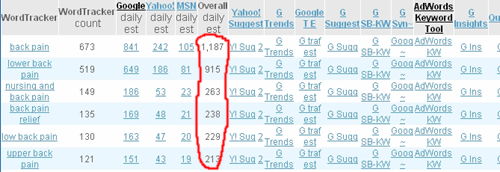
The objective is not to find long tail keywords. The objective is to find keywords with enough demand and low competition, so that you can get top rank and traffic easily. Due to increasing competition, such keywords happen to be the longer tail keywords. That’s why the focus is on long tail keywords.
Another free tool that you can use to expand your keyword selection is Google Keyword Tool. Just type in your general keyword and it will return a list of keyword suggestions with monthly search demand.
3) Check the competitiveness of the keywords
From the above screenshot from KW Research, you now have a list of keywords arranged in order of the daily search estimate. This data takes care of the ‘demand’ for the keywords.
Your job now is to check the ‘competition’ of the keywords.
Starting from the keyword phrase with the highest demand, you now have to type the keyword phrase one by one into Google search and check the number of results it returns.
Here’s a checklist that I use to check the competitiveness of any keyword phrase.
i) Search result should be less than 500,000.
ii) Some of the webpages in the top 10 results should have a PR less than 3.
iii) Some of the webpages in the top 10 results are internal pages of Squidoo.com, Hubpages.com, Blogger.com, Ezinearticles.com and/or Buzzle.com.
For example, if I do a search for “lower back pain”, at the time of writing, I get 17,600,000 search results. The phrase is not a good keyword because with 17,600,000 other websites competing for the keyword, it’s going to take a lot of time and effort to list in the top 10.
Going down the list, I found “lower left back pain”. This keyword phrase returns 446,000 search results. Not bad. With SEO For Firefox, you can see that the top 10 websites mostly have PR 1 and 2. This seems to be an easy keyword to target.

Another keyword I tried is “exercises for back pain”. This keyword phrase returns 408,000 search results. It’s less than 500,000 results. But the top 10 websites mostly have PR 4 and 5. This means although there aren’t that many websites to compete with, it’s not easy to get the top 10 ranking because the top 10 are already conquered by authority sites.
That’s about all in long tail keyword research. Not too complicated isn’t it?
Long tail keyword research for PLRPRO users
All PLRPRO niches come with complete keyword research in an excel spreadsheet. Frankly, I seldom conduct keyword research for websites built using PLRPRO. In most cases, I simply use the keywords used in the PLR articles.
Some of the keywords may be competitive. But I don’t really care. Most of the keywords are long tail keywords anyway. I am very lazy when it comes to making money from Google Adsense.
So, if you want to conduct your own keyword research for all the 40 articles, by all means, go ahead. You should get better returns. For me, I didn’t do it.
Final note about long tail keyword research
Long tail keyword research is important. But besides the long tail keywords that you ‘intentionally’ optimize for, you will also get traffic from other long tail keywords that you never think of. While such traffic is not significant, the sum of these ‘insignificant’ traffic can add up to a few hundred traffic to your website.
Thanks very much for the tutorial. This is something I need to use for selecting appropriate keywords for my site.
The thing about long tail keywords and SEO is they are easier to rank for, and the people searching for them are more likely to be in a purchasing mode. A win win situation for all.
This is such a great article, it certainly opened by eyes to how long keywords work.
Thanks, keepup the good work
As an IT challenged newbie this has been a great help. Will be utilising it shortly. Thank you.
Thanks kenneth for the tip on the Firefox plugin, it will
make research a little easier.
yes i have now got to know that longtail keywords can now be handled easily great job thanks
Thanks so much for tipping us off to this great plug-in. Not only will it shave tons of time off of my long tail keyword research but it helps me keep track of my own sites and blogs.
Hi Kenneth:
Nice tutorial. Still, I wonder if this is a technique alike the one used in the so called “bum marketing” which, besides, uses also the quoted keywords or long tail keywords. Thank you.
Jesus Moreno
Hi Kenneth,
This is the first time I heard of firefox SEO plugin. Thanks for sharing. By the way, I used a free keyword difficulty analyzer to analyze competitions. I shared this quite in detail in one of my blog post. You can see the original post at http://www.marketersworld.net/2008/12/article-marketing-for-traffic-how-to_16.html
Thank you for the insightful article and will definitely put the knowledge to work.
Hi Kenneth,
Just a question regarding the plr article provided by PLRPRO. How do you built a site from it? I mean how do you built the site structure. Can you explain how it is done?
Kelvin,
I’ll answer this question regarding website structure in my next blog post on this coming Friday on 23 Jan 2009.
Hi Kenneth,
thanks for this in-depth information, there are so many tools available but the one you mentioned here is certainly worth to have a go.
In addition to post, the free utility synonymbase.com for selection keywords and as similar(wow!) keywords ;) Search over 200 million keys.
wonderful explanation about keyword selection, being new to blogging i have a plan to use this for my blog.
Thanx.
Thanks Ken…do you ever have problems with firefox stalling out. I love it but it won’t stay running for longer then 10 minutes. Any ideas?
A good way to get keyword suggestions is to use Google Adwords keyword tool. First, you need an Adwords account. Then start a new PPC campaign for your site and use the keyword tool to find not only keywords that people have searched on but also their monthly relative search volumes.
I need help to write Meta Title, Meta Keyword and Meta Description of Flowers. Tag….
Would you please help me on this?
Thank you,
Masukmian
Long tails are very efficient for easy targeting and good results.
Of course it is also important to make sure that you don’t target words irrelevant to your landing page. Sometimes long tails can have more then one meaning, and then you spend money on wasted traffic.
Other then that, very good tips.
Hi, Kenneth
Your explanation is really a K.I.S.S (Keep it simple and sweet). I learn something again from this post. Keep it up! I will share your post with my friends also.
Hi Kenneth,
Great tips.
I have a question, when I follow the method that specified above, I have to use the phrase only, or must with a bracket in it? What is the difference?
For example:
traffic generation OR “traffic generation” OR [traffic generation]?
Thanks
I just use the phrase, without any quote or bracket.
Hi Kenneth,
Thanks for such a great article outlining keyword phrase research. I have a question. I noticed that your instructions are based on a broad search. I have learnt in the past that you should do your competition research using the following: allintitle: “keyword phrase”. I would like to understand why you don’t use this and if there is an advantage or no advantage to using “allintitle”.
Thanks,
Donna
Thank man ………………………….
Wow! Never know we could do that with Google Analytics! Thanks for the tip! Looking forward for more Google Analytics guides for web promotion.
too bad that long tail keyword now didn’t work on google’s new algorithm, we have to get another strategy
Hi,
Why long tail keyword not working with new Google algorithm?
Hi Kenneth,
If this is true, how are we going to do with our long tail keyword strategy?
Thanks
long tail keywords is still the way to go, though the game has changed a little because of the introduction of Google’s auto search suggestion.
Hi Kenneth,
Will this affecting our ranking on Google using article strategy through ezarticlelink?
Thanks
You bet it will, especially when you are targeting low competition keywords such as long tail keywords.
But with the new Google Caffeine, the game has really changed a little. Read my post on Google Caffeine to learn more. The focus is more on authority sites.
It’s a matter of finding the balance between keywords and search volume. I’ve seen that there are still long tail keywords with 3 words available and a decent amount of traffic attached to them, however as time passes, it will become more difficult to find these niches since the market will become more saturated and the new marketers coming in will have to only work with 4 work keywords.
That is such an excellent article, it certainly opened by eyes to how long keywords work.
Thanks, keepup the great work
I always have difficulties doing long tail keywordresearch but this is a nice guide
this is the best article i ever read on keyword research. very simple and powerful explanation. thanks for sharing….
Hey Cindy. Just remember when you are looking around for the amazon kindle, that the legit ones have copyright protection. So if you see a special offer and you see no copyright or the copyright does not match the name on the product BEWARE!
All the information you need on the amazon kindle can be found at:
http://www.my-kindle.net
Good Luck and like I said…be careful where you buy from! =)
Kenneth:
I am a newbie and looking forward to use your article distribution service, currently using the 30 article trial.
I am trying to follow your guidelines for looking for long tail words utilizing the free keyword tool from SEO for Firefox as you suggest.
I have a question and hope you can illuminate me:
I find some words on the SEO tool that comply with your guidelines of a google search with less than 500,000 results and some pages with PR below 3, however, the estimated searches for some words do not match with the results from the Google Adwords keyword tool, and by that I mean not that they’re off by little, but way off, for example for the words ‘low calorie meal replacement bars’ the SEO tool says that the average searches per day on Google are 93 per day which will be around 3000 per month, however the Google Adwords keyword tool says a total of 36 per month and I verified that the google keyword tool doesn’t have any filters applied to the search.
Can you give me a hint as to what is going on? I am afraid of using the keywords that SEO suggests to find out later that there are actually not enough searches for those words and the SEO tool is just miscalculating.
I understand that this question may be outside of what your responsibility is to respond to users of your service, I am just giving it a shot since you seemed to be very knowledgeable and may be able to answer me. Thanks in advance.
Very good article about keyword research. Its important to focus on long tail keywords as they are hot leads compared to short keywords where people are still thinking about things.
One of the simplest yet highly informative tutorials i ever read. By “SEO For Firefox Plugin” did you mean “SeoQuake SEO extension”
This is really interesting and thanks for sharing such important guide to long tail keywords..